Decide what business storage needs to solve
Before moving anything, identify the space you need back: a workshop bay, a stockroom aisle, an office or a garage used by a home business. Then choose what can leave without interrupting orders or paid work.
Business Queensland advises balancing the benefit of readily available stock against costs including storage, freight, insurance and labour. More room is not automatically a good reason to keep stock that no longer sells. 1
Ipswich City Council identifies logistics and manufacturing among the city's investment strengths. 2 QGSO reports a preliminary official estimated resident population of 268,272 people for the Ipswich local government area at 30 June 2025—not a 2026 count or a projection. 3 Growth provides context, but your own workload and stock records should drive the storage decision.
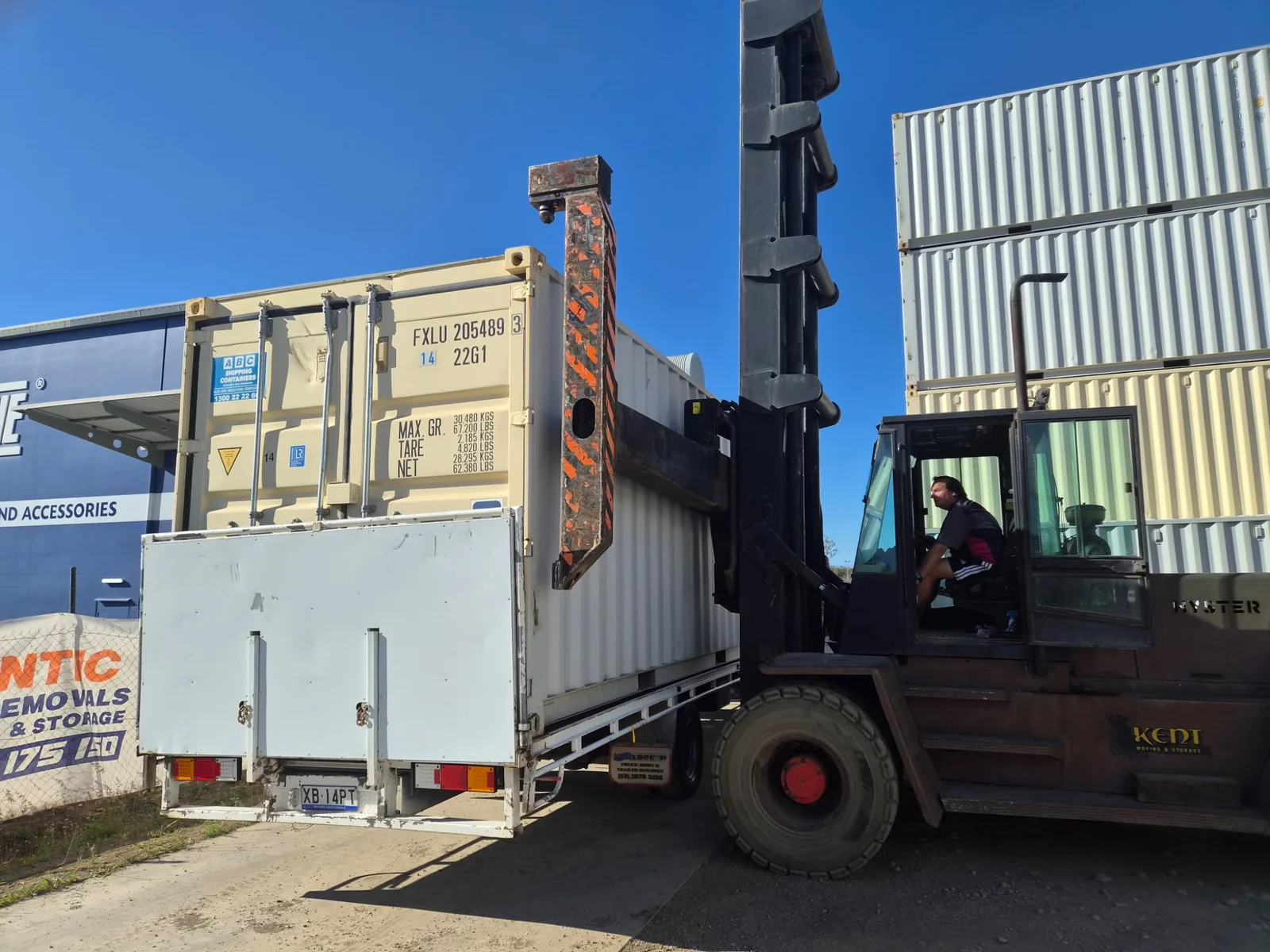
Container storage through IPSWICH CONTAINER STORAGE involves delivery to a property, professional loading, collection, locked storage in a monitored yard and return transport. Short- and long-term storage are available; confirm availability and suitability for your goods and address before booking.
Keep working stock where it can work
Sort by the next time you will need it
Divide items into three groups: needed for current work, needed on a predictable future date, and no longer useful. Keep daily tools, active orders and essential spare parts at your working premises unless an agreed retrieval arrangement genuinely meets your needs.
For example, a workshop in Bundamba might consider putting unused office furniture away during a layout change while retaining tools for booked jobs. A retailer in Booval could assess seasonal display fittings for storage rather than moving stock customers buy every day. These are planning examples, not confirmation that particular goods will be accepted.
For each proposed item, ask:
- When is its next realistic use?
- What happens if it cannot be returned at short notice?
- Is keeping it worth the storage and transport cost?
- Could it be sold, returned to a supplier or disposed of appropriately instead?
Business Queensland suggests reviewing slow-moving stock and considering supplier returns or a sale to free space and cash. 1 Storage should not turn obsolete stock into an ongoing bill.
Make stored inventory traceable
Give every carton or item a location
Create the inventory before loading, while quantities and condition are easy to check. Business Queensland describes manual systems using spreadsheets and item labels or codes, including each item's stored location. 1
Your list should record an item or carton code, description, quantity, condition, value for insurance discussions, intended return date and the person responsible. Add serial numbers for equipment and photographs where useful. Keep a copy outside storage so staff can answer questions without opening cartons.
Label cartons on more than one side and group related components together. A dismantled counter is less useful if its brackets and fixings cannot be identified. Match the labels to your inventory rather than relying on broad descriptions such as “miscellaneous”.
When stock moves out or comes back, update its location in your existing system so nobody mistakes stored goods for stock available for immediate dispatch. Discuss loading order with the team if some items are due back sooner. Do not assume individual cartons can be retrieved from the yard; confirm how access and returns actually work.
Check every item for storage compatibility
Separate ordinary overflow from specialist requirements
Furniture, display fittings and boxed non-perishable goods may be candidates for assessment, but acceptance is item-specific. Describe materials, dimensions, weight, condition and any manufacturer's storage requirements when enquiring.
Do not assume container storage provides climate control or suits food, temperature-sensitive products, precision equipment or specialist archives. Damp cartons, textiles or equipment need attention before packing; enclosing moisture does not remove it. Ask the business about packing and preparation rather than guessing.
Flag fuel, oils, chemicals, aerosols, gas cylinders, batteries and anything potentially hazardous before making arrangements. Do not send these with ordinary goods unless their acceptability has been explicitly confirmed. This service should not be treated as a dangerous-goods storage facility.
For records, first ask whether originals are needed and what confidentiality, retention and environmental requirements apply to your business. Keep frequently needed documents accessible and obtain appropriate professional advice where obligations are involved. Ordinary storage is not a promise of specialist document preservation or records-management compliance.
Plan delivery and loading around the premises
Send photographs and details of the proposed delivery location. Include gates, driveway surfaces, slopes, overhead obstructions, shared parking and the route from the goods to the loading area. The business must confirm site suitability; a space that looks large enough is not necessarily suitable for delivery.
At a leased shop or workshop, check proposed arrangements with the landlord or property manager. If loading could affect a shared driveway or public area, establish whether permission or approvals are needed before setting a date. Keep the plan clear of customer movements and routine deliveries.
A home-business move in Ripley may combine household furniture with business equipment. ABS identified the Ripley statistical area as Queensland's largest-growing SA2 by population increase in 2024–25; that finding concerns an official population estimate, not business demand or storage availability. 4
Keep household and business inventories separate. Our moving house in Ipswich guide can help with the household side. If work is being staged around building works, the temporary storage during renovations guide offers related planning ideas.
Compare the full cost and set review dates
Ask for a quote based on the actual goods, location and expected duration. Confirm what delivery, professional loading, collection, storage and return transport include, and ask about charges for changed dates or any agreed access arrangements. Do not compare storage prices alone.
Check insurance with both the business and your insurer. Ask what cover, if any, applies while loading, in transit and in storage, along with exclusions, limits, excesses and evidence required for a claim. Locked storage in a monitored yard does not establish insurance cover or a particular security standard.
Set a review date when storage starts. For seasonal items, tie it to the next selling period; for a premises change, tie it to fit-out progress. Reassess whether goods still have a use, whether quantities have changed and whether the return date remains workable.
Arrange storage with a workable return plan
Before booking, confirm:
- Which goods are accepted and how they should be prepared.
- Site suitability, availability and proposed loading dates.
- Access arrangements, notice requirements and any associated charges.
- Insurance responsibilities and the full written quote.
- Return transport timing and who will receive the goods.
Nominate one person to manage inventory changes and dates. If your operation depends on frequent picking or urgent replenishment, explain that upfront: do not assume instant retrieval or 24/7 access.
For a practical discussion about freeing up business space, send an enquiry to IPSWICH CONTAINER STORAGE or call 0481 175 150. Have your item list, property details and likely storage period ready so the team can confirm what is suitable and provide a quote.
Common questions
Frequently asked questions
Can I collect business stock whenever I need it?
Do not assume drop-in, instant or 24/7 access. Confirm access arrangements, notice requirements, charges and how goods can be returned before booking. If you need daily picking or urgent spare parts, explain that requirement and keep essential items at your working premises unless a suitable arrangement is confirmed.
Can business equipment, chemicals and documents go into the same container?
Acceptance and compatibility must be confirmed item by item. Disclose chemicals, fuel, gas cylinders, aerosols, batteries and any specialist storage requirements before arranging loading. Do not assume dangerous-goods storage, climate control or specialist archive conditions are provided. Ask about appropriate preparation and separation of accepted goods.
What information should I provide for a business storage quote?
Provide an itemised list with quantities, dimensions, weights where known, photographs, your address and proposed loading location. Include the expected storage period, return date and access needs. Ask for confirmation of site suitability, availability, accepted goods, transport and loading inclusions, insurance responsibilities and any charges for changed arrangements.
Explore nearby storage areas
Find the existing service information for relevant locations.
Sources & further reading
Official information checked for this guide on 4 November 2026. Source reference periods are noted alongside statistics; estimates and projections are not interchangeable.
- Business Queensland — Stock control: the basicsLast reviewed and updated 16 November 2022; accessed 4 November 2026. Supports balancing available stock against storage, freight, insurance and labour costs; reviewing slow-moving stock; spreadsheets, labels, item codes and stored locations. No numerical statistics or tax rules reproduced.
- Ipswich City Council — InvestNo publication or update date displayed; accessed 4 November 2026. Supports the qualitative local context of logistics and manufacturing in Ipswich's investment focus. Promotional catchment figures and unqualified growth claims are not reproduced.
- QGSO — Population growth, regional Queensland, 2024–25Published 31 March 2026, as confirmed by QGSO's official regional population releases index; accessed 4 November 2026. Table 1 reports Ipswich City local government area estimated resident population of 268,272 persons at 30 June 2025. This is a preliminary official ABS population estimate, not a projection, 2026 population count or Census result. The report identifies 30 June 2024 estimates as revised and 30 June 2025 estimates as preliminary.
- ABS — Regional population, 2024–25 financial yearReleased 31 March 2026; accessed 4 November 2026. Reference period is the 2024–25 financial year. Supports Ripley SA2 in Ipswich being Queensland's statistical area with the largest population increase for that period. Population and growth refer to official estimated resident population, not projections or 2026 Census results; no numerical growth value is reproduced in the article.